date: 2026-01-24
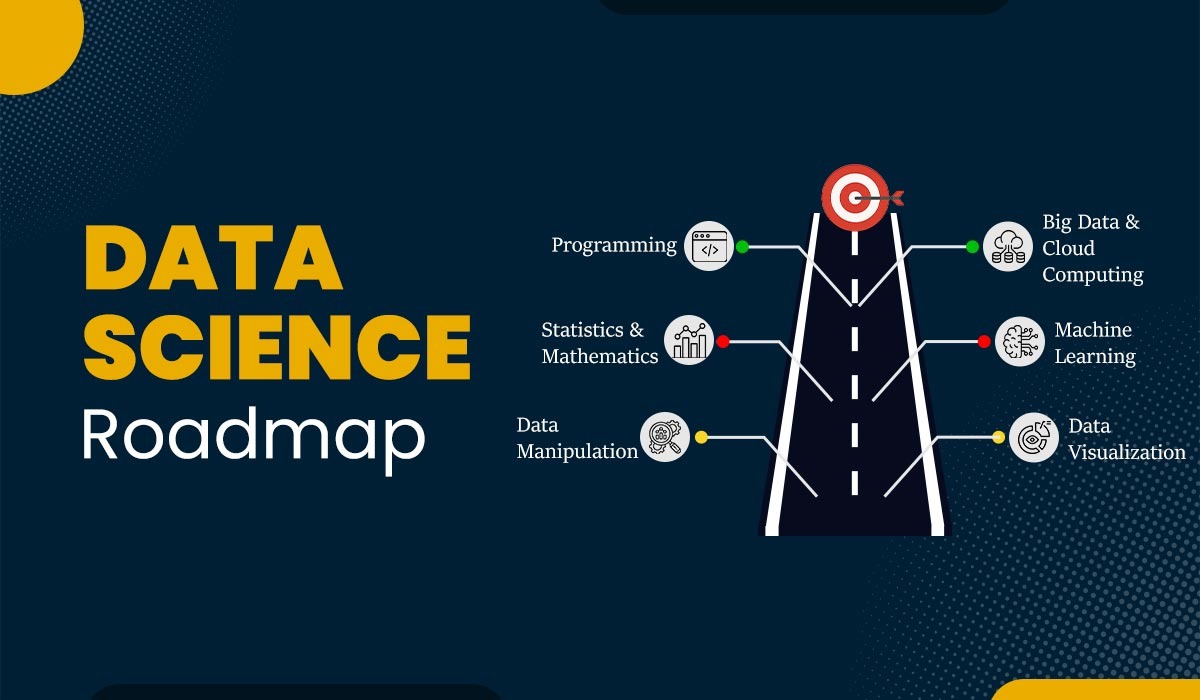
My Practical Data Science Learning Roadmap (From Beginner to Job-Ready)
If you are confused about where to start in Data Science, what to learn, and in what order – you are not alone.
I was in the same place.
So instead of hoarding courses and watching random YouTube videos, I created a clear, practical roadmap that I follow.
This post is a breakdown of that roadmap.
Phase 1 – Python Foundations (Non-Negotiable)
Before touching ML or AI, you must be comfortable with:
- Variables, data types, loops, functions
- Lists, dictionaries, tuples, sets
- File handling
- Basic OOP
Goal:
You should be able to write small scripts without Googling every line.
Phase 2 – Data Handling with NumPy & Pandas
This is where real Data Science starts.
Learn: - NumPy arrays, indexing, vectorization - Pandas DataFrame, Series - Filtering, sorting, grouping - Handling missing values - Merging and joining datasets
Goal:
You should be able to take a raw CSV and clean it confidently.
Phase 3 – Data Visualization
Because data is useless if you can’t explain it.
Tools: - Matplotlib - Seaborn - (Later) Plotly for interactivity
Learn: - Line plots, bar charts, histograms - Box plots, heatmaps - Trend analysis
Goal:
You should be able to tell a story with data.
Phase 4 – Exploratory Data Analysis (EDA)
This is where you start thinking like an analyst.
Focus on: - Understanding distributions - Finding patterns - Detecting outliers - Asking the right questions
Goal:
You should be able to say why something is happening, not just what is happening.
Phase 5 – Statistics & Probability (Critical, Not Optional)
Most people skip this. Big mistake.
Learn: - Mean, median, variance, standard deviation - Probability basics - Normal distribution - Correlation - Hypothesis testing
Goal:
You should understand what your model is actually doing.
Phase 6 – Machine Learning
Start with: - Linear Regression - Logistic Regression - KNN - Decision Trees - Random Forest
Then: - Model evaluation - Overfitting vs Underfitting - Cross-validation
Goal:
You should be able to train, evaluate, and explain a model.
Phase 7 – Projects (This is Where Most People Fail)
Without projects, skills are useless.
Build: - End-to-end ML projects - Data analysis projects - Dashboards - Real datasets (not toy data)
Goal:
You should have proof of work, not just certificates.
Phase 8 – Advanced (Optional but Powerful)
- Deep Learning
- NLP
- RAG
- MLOps
- Deployment
Only after strong fundamentals.
Final Advice
Do not chase everything at once.
Do not compare your Chapter 1 with someone else’s Chapter 20.
Consistency beats intensity.
I am following this roadmap and documenting everything on this blog.
If you are also learning Data Science, feel free to follow along.
Let’s build, not just consume.